
News
Media and broadcasting play an undeniable role in the domain of sports ad sports events. It transforms local events into global events and helps in building and maintaining connections among fans and followers of various sports at a global level. Fans at the global level can feel the level of excitement from any location, even when one is away from the venue of the sport event.
This dependence on media and broadcasting did not happen overnight in the domain of sport. The main reason why mass media got into the domain of sport was primarily because the sports events management groups and companies felt the need to promote their sport, which would help in increasing the popularity of the sport among the readers or viewers of the sport through mass media.
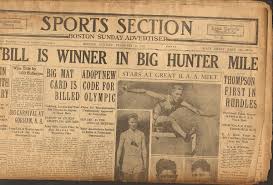
The bonding of sports and media is of a complex nature, and did not start very recently. In fact, newspapers that existed in the US and in Europe, gave coverage to sports events taking place in the continents even in the late nineteenth century, and even before, though the percentage was lower. From the late nineteenth century, sports began to be widely associated with the lives of people, and hence, the growth in coverage. In fact, the earliest specialised sports news coverage was done by England’s The Sporting Magazine in 1793, focusing on horse racing. The New York World became the first newspaper to have a full time sports department from 1883.
Since 1920, there was a boom in the coverage of sports events through newspapers, and the unbreakable relationship between sports and media deepened, with the gradual onset of visual and digital media, like television, and radio. Broadcast through television and radio took sports commentary to a different level – it went from home to home to different parts of the world, as sports enthusiasts started to get the news of the sports events at the real time, when the game was happening in some other part of the world, right at the comfort of their house.
Significantly increasing fan connection with sports events and sports personalities, media and broadcasting has largely impacted the commercial development of sports. Media involvement means a major revenue for sports leagues, teams, athletes and governing bodies. Since 1970s, sports has evolved as a big industry, as it is completely in the hands of media to decide which sport or which athlete will make money, and which sport is more popular among the spectators. Media is often seen to be biased and popularizing only a few sports, which are already popular thereby sidelining the sports which are less popular.
In today’s world, where social media platforms like Facebook, Instagram and X are door-to-door names, the popularity of sports events and even athletes, depend on these social media platforms. In fact, these social media platforms define which athlete will be shaped to fame, who is more popular than the others, in terms of the number of followers or comments they have on their profiles, or posts, and even which sport is more popular or followed more by a greater audience.
This has also helped the athletes to connect with their fans and followers, and given rise to sports communities in all parts of the world. As the live match updates, fan polls and live chats happen on social media platforms, fans feel more engaged with the athletes as well as with the sports events, ts strengthening the stronghold of media on the common man.
With so many benefits that media has brought to sports, there are some concerns that linger in the overall development of sports. There is an excessive commercialization in the sports events as well as among the athletes, which is no doubt boosting the sport from the commercial and business point of view. But, in today’s world, the focus shifts away from sportsmanship towards profit.
Also, there is bias coverage, where only popular sports and popular athletes get all the coverage and attention, while the not-so-popular sports an d athletes remain unknown to the rest of the world despite the great contribution they have in the domain of sports.
Besides the positive impacts of media on sports, media and broadcasting industry should be more responsible, at least in today’s world, as media indeed has a major role to play in the lives of the spectators and followers. If ethical broadcasting and fair coverage start coming from media an d broadcasting agents, it will be more beneficial for the sports events, the sports management companies, as well as for the athletes.